Dental Bridges – Fixed Dental Prostheses as an Alternative to Implants
When a dental bridge is the right choice, what types are available, and how it compares to an implant – the complete overview.
Denis-Focus Dental
Mosonmagyaróvár, Hungary
April 24, 2026Approx. 6 min. reading time
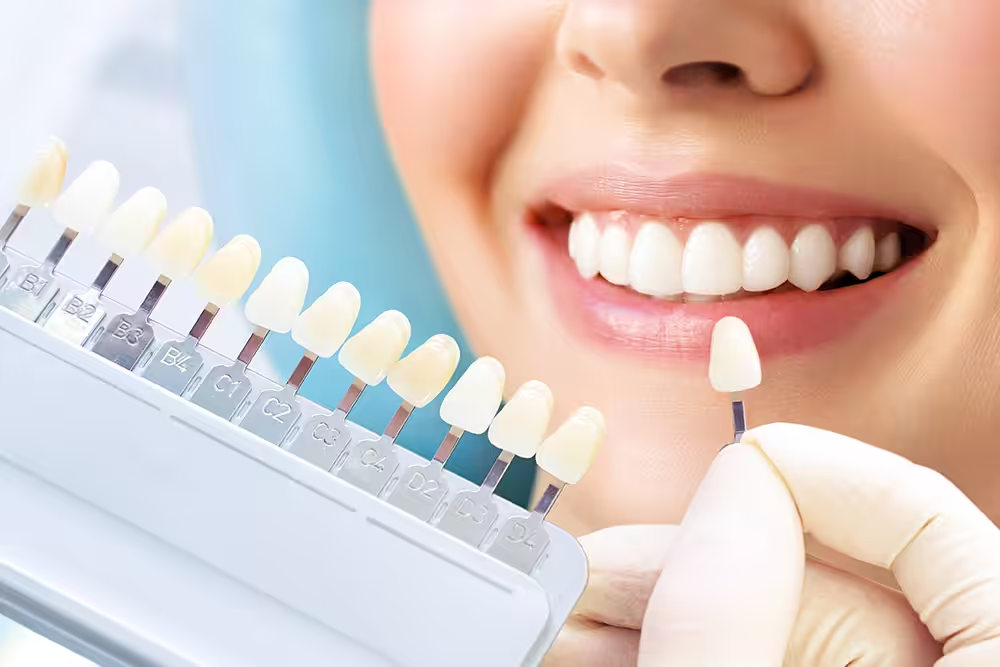
A modern zirconia dental bridge seamlessly closes gaps and is visually almost indistinguishable from natural teeth.
The most important things at a glance
One Dental bridge closes gaps of 1 or more missing teeth with fixed dentures.
It is anchored to adjacent teeth or on implants, depending on the initial situation.
Modern bridges are made of zirconium or full ceramic – completely metal-free and aesthetic.
Durability: 15–20 years and longer with good care.
What is a dental bridge?
One Dental bridge is a fixed dental prosthesis that closes one or more tooth gaps in the dentition. It typically consists of three parts: two crowns on the adjacent teeth (the so-called abutment teeth) and a pontic in between, which replaces the missing tooth. The result looks like a closed row of teeth – without a prosthesis needing to be removed.
Dental bridges are among the classic solutions in dentistry, and even today they remain a reliable, proven method. With modern materials such as Zirconium oxide and digital manufacturing CAD/CAM it reaches a quality today that would have been unthinkable a few years ago.
What types of dental bridges are there?
Depending on the starting situation, there are different types of bridges used in everyday life:
Conventional bridge
The classic, tooth-supported bridge. The two neighboring teeth are ground down and covered with crowns on which the pontic rests. Suitable for healthy, stable abutment teeth.
Implant-supported bridge
Instead of teeth, Dental implants used as a pillar. Ideal when neighboring teeth are weakened or missing – or when healthy teeth are not to be ground down.
Adhesive bridge (Maryland bridge)
A very gentle variant where the bridge abutment is bonded to the neighboring teeth with flat wings – without grinding them down. Today, it is primarily an elegant solution for front tooth gaps in younger patients.
Long-span bridge
If multiple teeth are missing in a row, a long-span bridge spans several units – as long as there are enough stable abutments. For very long gaps, we carefully consider whether implants are advisable as additional abutments.
Materials – Zirconia, All-Ceramic, or Porcelain-Fused-to-Metal?
The choice of materials influences the aesthetics, durability, and price of Dental bridge:
Zirconia bridge Extremely stable, metal-free, natural looking – the most popular choice today.
All-ceramic bridge (lithium disilicate): Highest aesthetics, ideal for the anterior region.
Porcelain-fused-to-metal bridge (PFM) classic, very stable variant with a metal core and ceramic veneer. Cheaper, but not quite as natural-looking.
„The right bridge isn't expensive or cheap – it's fitting. Well-planned and well-made, it lasts for many years, just like your own teeth."
Dental bridge or implant?
A common question in consulting: should the gap be filled with a Dental bridge or fitted with an implant? Both solutions have valid areas of application.
Advantages of a dental bridge
Faster treatment (often completed in 2-3 sessions)
No surgery – no implantation, no months-long healing phase
Lower costs compared to comparable implant treatment
Advantages of the implant
Adjacent teeth do not need to be ground down
Bone preservation through implant (the bridge cannot do that)
Often longer durability than a tooth-supported bridge
In many cases, the decision is individual: If the adjacent teeth are already crowned or heavily decayed, a bridge is often the better choice (they would be crowned anyway). If the adjacent teeth are perfectly healthy, an implant is often the more tooth-conserving option.
Treatment procedure
The creation of a Dental bridge at Denis-Focus Dental proceeds in clearly defined steps:
Diagnosis and Planning X-ray, assessment of abutment teeth, material selection.
Preparation of abutment teeth: gentle grinding under local anesthesia.
For German-speaking patients, we plan the process so that generally 2 trips to Hungary sufficient: one for preparation and impression, a second for the placement of the finished bridge. In individual cases, completion in a single week is possible.
Care and durability
One Dental bridge With proper care, it lasts 15-20 years or longer. Cleaning in the area of the bridge connection is particularly important - dental floss with a threader, superfloss, or interdental brushes are helpful here. At Denis-Focus Dental, we will show you how to optimally care for your bridge in a personalized instruction session.
Frequently Asked Questions about Dental Bridges
One Dental bridge is a fixed dental prosthesis that closes one or more missing teeth. It consists of several interconnected crowns: the abutment crowns on the neighboring teeth and the pontic, which replaces the missing tooth.
One Dental bridge It is sensible when one or more adjacent teeth are missing and the surrounding teeth are healthy and stable enough to serve as anchors. It is a tried-and-tested, fixed solution – often less expensive than an implant.
Both solutions have advantages. An implant stands completely on its own and preserves the neighboring teeth, but it is more complex to treat. A Dental bridge is faster and cheaper, but requires grinding the abutment teeth. The best solution depends on the individual case.
A well-maintained Dental bridge lasts 15 to 20 years, often even longer. Crucial factors are careful oral hygiene, regular check-ups, and the right choice of material – modern zirconium bridges are particularly durable.