Digital Smile Design – Your new smile planned digitally
How modern technology makes aesthetics predictable – you'll see the results on the screen before the treatment even begins.
Denis-Focus Dental
Mosonmagyaróvár, Hungary
April 26, 2026Approx. 6 min. reading time
With Digital Smile Design, you can see your new smile on the computer – long before the first tooth is treated.
The most important things at a glance
Digital Smile Design (DSD) Plan your new smile digitally - before the actual treatment.
Photos, videos, and 3D scans form the basis for individual design.
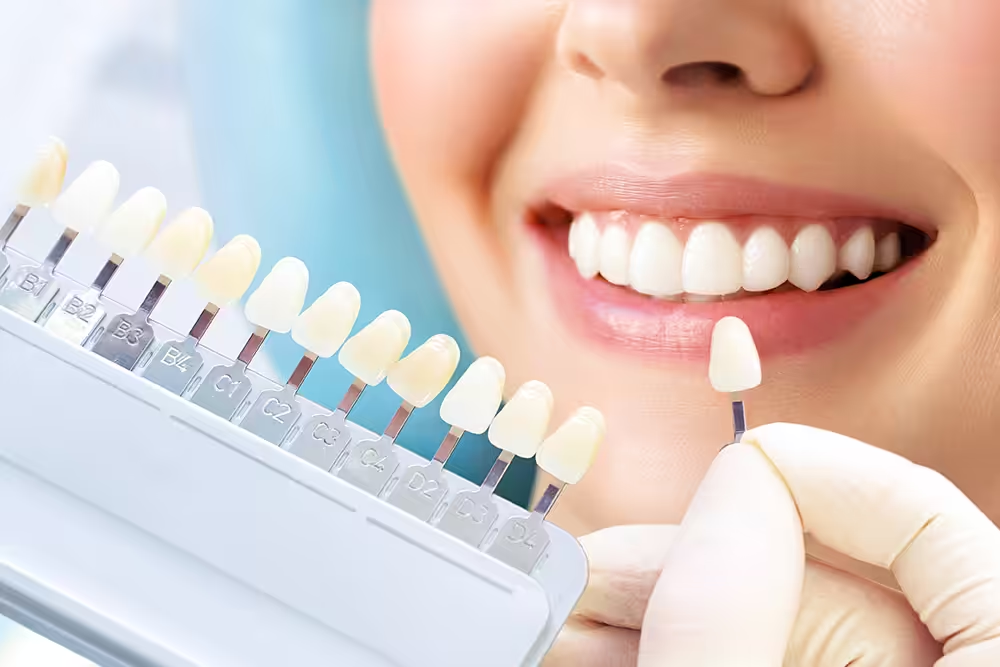
With a mockup, you can see the result on your own teeth beforehand.
Ideal for veneers, crowns, smile makeovers, and complete aesthetic rehabilitations.
What is Digital Smile Design?
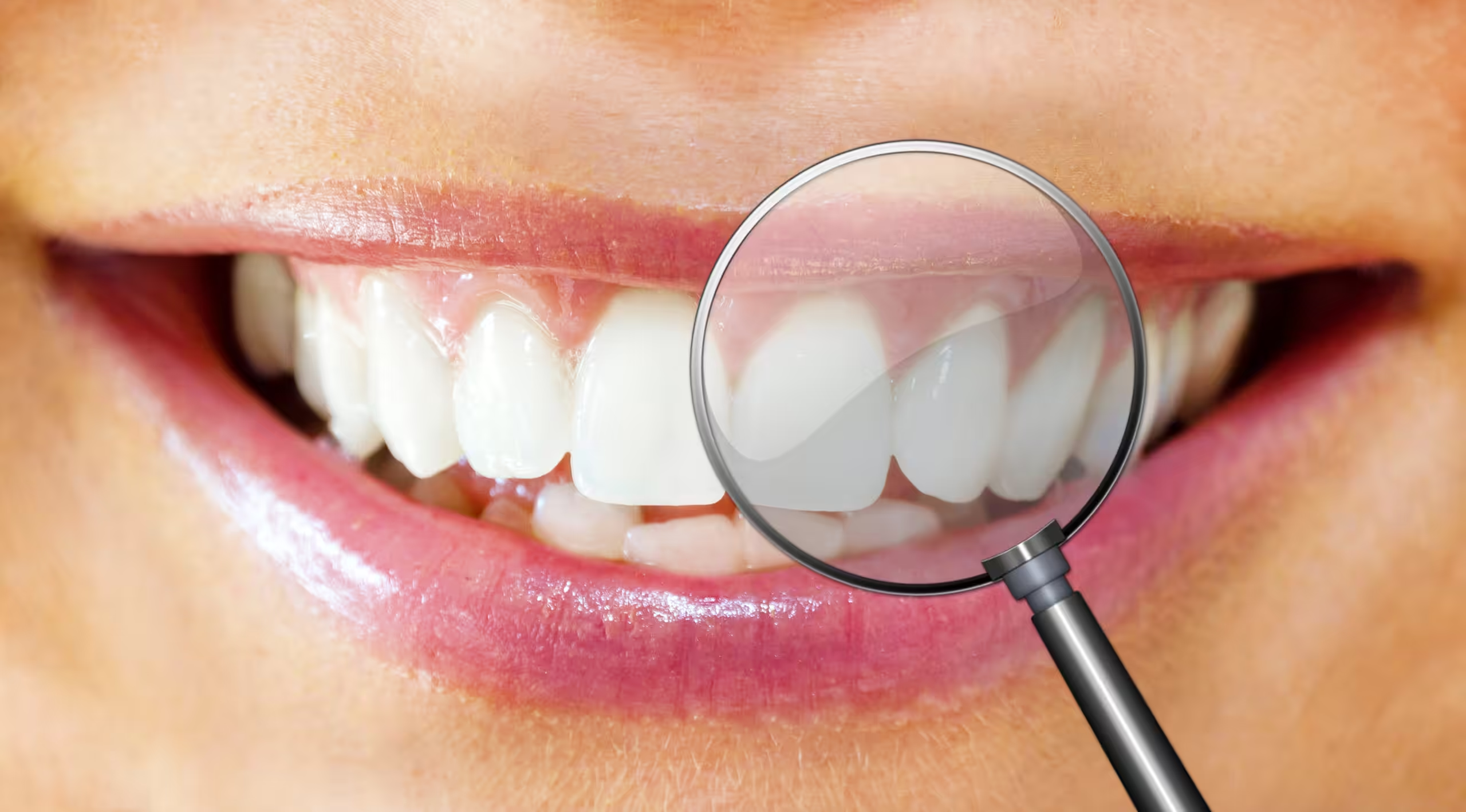
Digital Smile Design – short DSD – is a modern, computer-aided method for planning aesthetic dental treatments. Instead of relying on intuition or pure description, your individual dream smile is designed and visualized on the computer – always in relation to your lips, your face, and your personality.
The goal: a smile that naturally suits you – not a standard „Hollywood smile," but the most aesthetically harmonious version of your own teeth. To achieve this, the dentist considers not only the teeth but the entire interplay of your lip line, facial midline, tooth axes, and proportions.
„A beautiful smile doesn't start with the teeth – it starts with the face. Digital Smile Design considers both, together."
Why digital planning makes a difference
Before the introduction of digital procedures, aesthetic dental treatments were often based on wax models and verbal agreements. Today, it creates Digital Smile Design a new level of transparency and precision:
Visual Security You see the planned result before you decide.
Individualization Every detail – tooth shape, tooth length, position – is customized for you.
Communication The dentist, patient, and dental laboratory work with the same digital templates.
Precise implementation: The digital plan is transferred 1:1 to the manufacturing of the crowns, veneers, or bridges.
Fewer surprises: Adjustments are made digitally – not on the finished dental prosthesis.
The process of DSD treatment
The Digital Smile Design-Planning consists of several clearly defined steps that together provide a complete preview of your new smile:
Photos and videos
We take high-resolution photos of your face – from the front, side, while laughing, and while speaking. These not only document the current situation but also how your lips and muscles move. This allows us to plan a smile that looks natural when you're smiling.
2. Digital 3D Scan
Your teeth will be with a 3D intraoral scanner captured. In just a few minutes, an exact three-dimensional model of your teeth is created – without unpleasant traditional impressions.
3. Digital Design on the Computer
On the screen, we design your new smile. Tooth shape, tooth length, tooth position, midline, proportions – everything will be harmoniously matched to your face. You'll see the result in a realistic preview.
4. Discussion and Adjustment
You provide feedback on the draft, and we'll adjust. Would you like a slightly brighter white? A rounder tooth shape? Smaller or larger incisors? All of this will be tested digitally until you're satisfied.
5. Implementation into Treatment
Once approved, the digital draft will be brought into reality as Zirconia crown, full ceramic crown or bridge, made with CAD/CAM technology.
Good to know
Digital Smile Design is no standalone treatment step, but a planning and visualization method that can be combined with almost all aesthetic treatments: crowns, bridges, veneers, implant restorations, and complete smile makeovers.
Digital Smile Design is suitable for anyone who wants to improve their smile. This includes people who have:
* Gaps between their teeth
* Chipped or broken teeth
* Misaligned or crowded teeth
* Discolored or stained teeth
* Reshaped or restored teeth
* Are looking for a more youthful appearance
Digital Smile Design is particularly valuable for:
Patients who want to aesthetically improve multiple front teeth
Patients planning a smile makeover
Patients with misaligned teeth or unaesthetic tooth shapes that they wish to correct.
All who want certainty about the final outcome before a major treatment
Frequently Asked Questions about Digital Smile Design
Digital Smile Design (DSD) is a digital planning method in aesthetic dentistry. With photos, videos, and 3D scans, your individual new smile is designed on the computer – including tooth shape, tooth position, and harmony with your face.
High-resolution photos and videos of your face and smile will be taken. Your jaw will be digitally captured with a 3D intraoral scanner. Then, we will design your new smile on the computer and show you the result before you decide to proceed with treatment.
Digital Smile Design This is suitable for all patients who want to aesthetically improve their smile – for example, with dental crowns or complete smile makeovers. Especially recommended for larger treatments involving multiple teeth.
Fixed dentures on 4 or 6 implants – permanent teeth in a short time
When an entire jaw needs new teeth, this method is often the best solution – a comprehensive guide on the procedure, benefits, and costs.
Denis-Focus Dental
Mosonmagyaróvár, Hungary
April 17, 2026Approx. 7 min. reading time
With only 4 to 6 implants, an entire jaw can be permanently restored with fixed dentures.
The most important things at a glance
Fixed dentures on 4 or 6 implants replaces all teeth in one jaw with a permanently anchored bridge.
The new bridge is as stable as your own teeth – no slipping, no removal for cleaning.
In many cases, fixed temporary restorations can be placed on the same day as the surgery.
At Denis-Focus Dental in Hungary, you can save up to 50% compared to the cost in Austria—while receiving the same quality of care.
What does fixed dentures on 4/6 implants mean?
A toothless jaw or a set of teeth that can no longer be saved used to be synonymous with a removable complete denture—a solution that can slip when speaking and cause pressure when eating. With fixed dentures on 4 or 6 implants Is there a modern alternative available today that completely overcomes these disadvantages?.
The principle is astonishingly efficient: In the jaw, only 4 to 6 Dental implants Generally, two implants are placed in the front area and two to four at an angle in the side area. A fixed bridge is anchored to these implants, which replaces all the teeth in a jaw. The result looks, feels, and functions like your own teeth – only permanently and without the typical denture problems.
The special advantage: Because the posterior implants are placed at an angle, treatment can often be performed without complex bone augmentation, even with reduced bone availability. In many cases, a fixed temporary prosthesis can be fitted on the same day as the surgery – you leave the practice with fixed teeth.
„Permanent new teeth in a short time – without removable dentures, without complex bone augmentation, with predictable duration and manageable costs."
Who is this solution suitable for?
Fixed dentures on 4 or 6 implants is the right choice, especially for the following patient groups:
Patients with a edentulous upper or lower jaw, who do not wish to wear a removable denture.
Patients whose Remaining teeth no longer restorable and in which the entire jaw needs to be restored.
Holder of a Full denture, who are dissatisfied with their grip, speech, or sense of taste.
Patients with reduced bone mass, in cases where conventional implantation involving extensive bone grafting is to be avoided.
We will clarify whether the treatment is also possible in your individual case during a free initial consultation based on a current X-ray. In some situations, a smaller [procedure/examination/etc.] is also necessary. Bone augmentation meaningful - we'll discuss that individually.
4 implants or 6 implants - what's the difference?
The decision of whether to use 4 or 6 implants per jaw depends on several factors: the available bone, chewing power, jaw shape, and, last but not least, the individual desired outcome.
Dental prosthesis on 4 implants
The 4-implant variant is efficient, attractively priced, and sufficient in a great many cases. The implants are strategically placed to securely support the full-arch bridge – usually two straight in the front region and two angled in the posterior region. This method is particularly well-proven in the lower jaw.
Dental prosthesis on 6 implants
If more chewing power is desired or the bridge needs to be longer (e.g., to the back molar), 6 implants are the more stable choice. Even in the upper jaw—where the bone is softer than in the lower jaw—the additional anchoring can be beneficial.
Treatment process – from planning to the finished bridge
Treatment with fixed dental prosthetics on 4/6 implants takes place in planned steps, which we specifically tailor to German-speaking patients from Austria and Germany.
Digital planning with DVT X-rays
It begins with a three-dimensional DVT scan of your jaw. This allows us to precisely assess the available bone and plan the ideal position of each implant on the computer before the actual procedure begins.
2. Implant placement and immediate restoration
The implants are placed under local anesthesia and usually take 2 to 3 hours for one jaw. In many cases, a fixed temporary prosthesis is fitted on the same day – you will leave the practice with fixed teeth.
3. Unification Phase
During the 3- to 6-month healing period, you will wear the temporary prosthesis and can eat and speak normally. Most patients travel back home during this time and continue their daily lives.
4. Final Bridge
After complete healing, we will fabricate the final bridge out of zirconia. The bridge will be custom-designed and matched to your tooth color, tooth shape, and tooth position. You can learn more about the fabrication process in our article on CAD/CAM Dental Prosthetics.
Advantages over a removable complete denture
Who from a conventional full denture to fixed dental prosthetics on 4/6 implants often experiences a significant leap in quality of life:
Stubborn Seat: No slipping when speaking, no removing to eat.
Natural Chewing: Up to 90% of the biting force of natural teeth—a removable denture typically achieves only 30–40% of that.
No palatal coverage in the upper jaw the sense of taste is fully preserved.
Bone preservation The implants biologically stabilize the jawbone and prevent the otherwise typical resorption.
Feeling of security Don't worry about the prosthesis slipping when laughing or eating.
Costs in Hungary
Fixed dentures on 4 or 6 implants Is a significant investment in Austria or Germany – the costs per jaw can range from 15,000 to 25,000 euros. In Hungary, you get the same treatment, with the same premium implant systems and high-quality materials, for about half that amount.
Important: Saving here doesn't mean a loss of quality. Dentistry in Hungary has been working according to EU standards for decades, and Denis-Focus Dental exclusively uses materials and systems that are also standard in Western European practices. The price difference is made possible by lower operating and personnel costs on-site. We will prepare a personalized cost estimate for you within 24 hours – Contact us Gladly.
Frequently Asked Questions about Fixed Dentures on 4/6 Implants
In this method, a complete jaw is done with only 4 to 6 Dental implants implants, on which a fixed bridge is anchored. The bridge replaces all teeth in a jaw and is as stable as your own teeth – no slipping, no removal.
The solution is particularly suitable for patients with a toothless jaw, unrestorable teeth, or problems with a removable complete denture. Treatment is often possible even with limited bone supply, as the implants can be placed at an angle.
The implant placement itself and the fitting of a fixed temporary prosthesis often occur on the same day. The final bridge is fitted after the 3–6 month healing period. For German-speaking patients, typically only 2 trips to Hungary are required.
With proper care and regular check-ups, it lasts fixed dentures on 4 or 6 implants 20 years and longer. The implants themselves can remain in the jaw for a lifetime. The bridge placed on top will be replaced after many years if necessary.