CAD/CAM Dental Prosthetics – Modern Digital Manufacturing of Crowns and Bridges
How computers play a central role in modern dental prosthetics – and what that means for patients.
Denis-Focus Dental
Mosonmagyaróvár, Hungary
April 30, 2026Approx. 6 min. reading time
Modern milling and 3D printing technology produces tooth replacements today with a precision that would be difficult to achieve by hand.
The most important things at a glance
CAD/CAM stands for Computer-Aided Design and Computer-Aided Manufacturing.
Dental prosthetics are planned digitally and milled or printed by computer from a material block.
Higher precision, consistent quality, faster production – and repeatably exact results.
Usable for crowns, bridges, veneers, inlays, dentures, and implant abutments.
CAD/CAM stands for Computer-Aided Design/Computer-Aided Manufacturing.
The abbreviation CAD/CAM stands for Computer-Aided Design (Computer-Aided Design) and Computer-Aided Manufacturing (Computer-Aided Manufacturing). In modern dentistry, this refers to a digital process that has revolutionized the planning and manufacturing of dental prosthetics.
In the past, crowns, bridges, and inlays were handcrafted in dental laboratories. Today, dental technicians plan the restoration on the computer, and a high-precision milling machine or a 3D printer fabricates the dental prosthesis from a block or powder – with an accuracy that would be difficult to achieve manually.
The digital workflow – from scan to milling machine
A modern CAD/CAM Dental Prosthetics goes through a clearly structured digital process at Denis-Focus Dental:
1. Digital Impression
The dentist scans your teeth with a 3D intraoral scanner. The resulting 3D data is the basis for all further steps – without traditional impression material.
2. CAD – Digital Design
The dental prosthesis is designed on the computer. The technician shapes the form, size, surface, and fit exactly according to the individual specifications of the patient and the digital jaw data.
3. CAM – Computer-Aided Manufacturing
The finished digital design is sent to a computer-controlled milling machine or an industrial 3D printer. There, the dental prosthesis is created – milled from a Zirconium oxide, full ceramic or titanium block, printed from special medical plastics, or manufactured in a sintering furnace.
4. Finishing
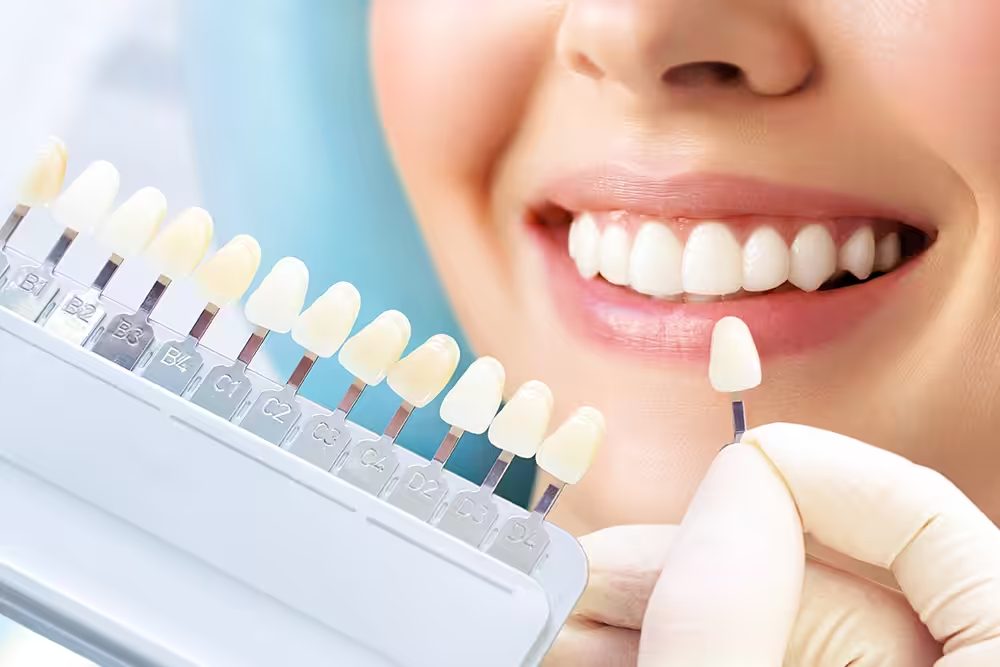
After manufacturing, the dental prosthesis is hardened in a sintering furnace, individually colored to the desired tooth shade, and – depending on the material – veneered with a ceramic layer to achieve natural translucency.
5. Integration
The completed dental prosthesis is fitted into the mouth, its function is checked, and it is permanently fixed. Thanks to digital planning, it usually fits perfectly from the start.
„CAD/CAM transforms dentistry from a handcrafted work of art into a reproducible precision process—without losing the human eye for detail."
What materials are used?
The CAD/CAM technology opens up a wide variety of materials today:
Zirconium oxide Extremely hard, biocompatible, metal-free – standard material for crowns and bridges.
Lithium disilicate (glass-ceramic): High aesthetic quality, ideal for front teeth and veneers.
Hybrid Ceramic / PICN A combination of ceramic and polymer, easily repairable.
High-performance PMMA for temporary restorations and long-term temporaries.
Titanium and Cobalt-Chromium for implant abutments and prosthesis frameworks.
CAD/CAM is suitable for which dental prostheses?
Virtually all modern dental prosthetic forms are manufactured, at least partially, digitally today:
Frameworks for telescopic and removable partial dentures
Good to know
Digital planning of your dental prosthesis remains permanently archived. If an identical crown or replacement is needed after years, manufacturing can be repeated exactly based on the original data – even if years have passed.
The advantages at a glance
For the patient, it means CAD/CAM Dental Prosthetics above all, one thing: better results in less time. Specifically, this means:
Higher precision as a manually fabricated dental prosthesis
Consistent Quality – All dental prosthetics are equally good, regardless of the day or the technician
Faster manufacturing – often in a few days rather than weeks
Better fit – less readjustment during integration
Reproducibility – if necessary, an identical dental prosthesis can be newly manufactured at any time
Frequently Asked Questions about CAD/CAM Dental Restorations
CAD/CAM stands for Computer-Aided Design and Computer-Aided Manufacturing. In dentistry, it refers to the digital planning and computer-controlled manufacturing of dental prosthetics such as crowns, bridges, and dentures—with the highest precision.
CAD/CAM Dental Prosthetics offers higher precision, consistent quality, faster manufacturing, and digital documentation that can be accessed at any time. The dentist and dental laboratory work with the same digital data.
With modern CAD/CAM technology, crowns, bridges, veneers, inlays, onlays, implant abutments, provisional restorations, and even complete denture constructions are manufactured.
No CAD/CAM Dental Prosthetics is usually comparable in price to conventionally manufactured dentures, but offers significant advantages in precision and durability.