All about dental implants - FAQ
01
What is a dental implant?
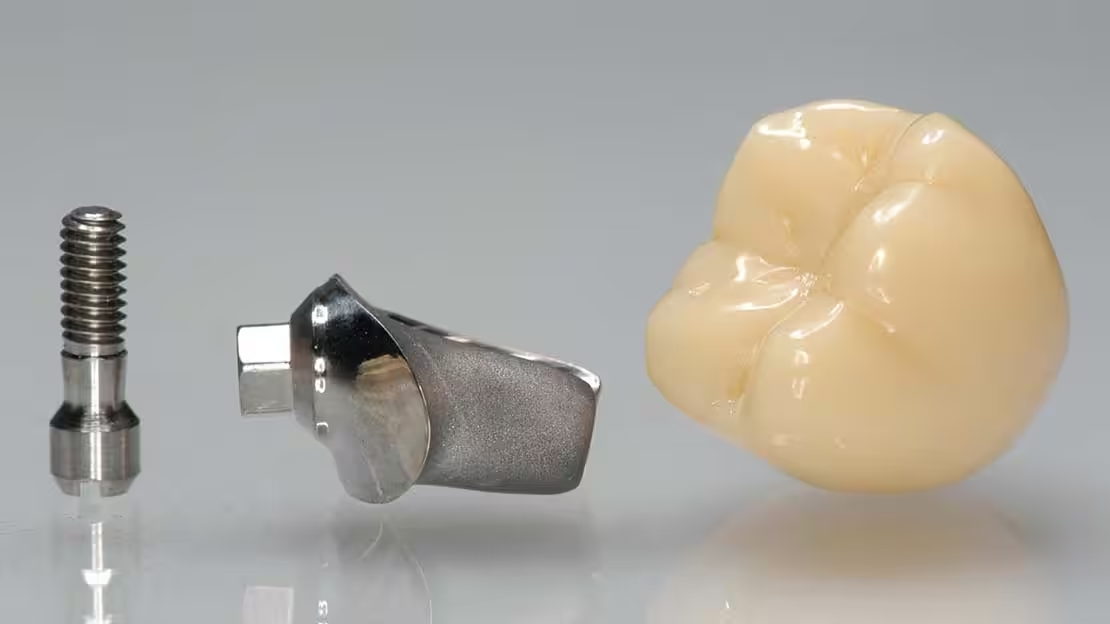
A dental implant is a Artificial tooth root made of high-purity titanium, which is surgically inserted into the jawbone. The titanium osseointegrated - grows directly together with the bone - and thus forms a stable, permanent basis for a dental crown, a bridge or a fixed prosthesis.
Today, dental implants are considered the gold standard in tooth replacement and replace missing teeth functionally and aesthetically like natural teeth.
Implant clinic - Expert answer
02
What costs are covered by health insurance for a dental implant?
The assumption of costs depends crucially on the type of insurance: Private health insurance cover up to 100 % of the implant costs, depending on the tariff. Statutory health insurance funds (GKV) usually only cover the general fixed allowance for dentures, but not the implant costs themselves.
As there are individual tariffs and supplementary insurances, we recommend that you contact your own insurance company directly. We will be happy to advise you on which documents you need.
Implant clinic - Expert answer
03
What costs are covered by health insurance for a dental crown?
The principle for dental crowns is similar to that for implants: Private health insurance cover up to 100 % of the crown costs, depending on the contract. Statutorily insured persons receive a fixed allowance that covers a proportion of the costs of the so-called standard care.
A co-payment is usually required for high-quality all-ceramic crowns or other premium solutions. Please enquire individually with your health insurance company.
Implant clinic - Expert answer
04
How long does a dental implant last?
With professional implant placement and consistent oral hygiene, dental implants can be last a lifetime. Long-term scientific studies prove this: After 10 years, about 95 % of all implants placed still fully functional.
Regular professional teeth cleaning, six-monthly check-ups and good home care with a toothbrush and interdental brushes are crucial for longevity.
Implant clinic - expert response based on long-term clinical data
05
Is the insertion of a dental implant painful?
No. The procedure is performed under local anesthesia and is therefore completely painless. Most of our patients report afterwards that the procedure was more pleasant than expected - comparable to normal dental treatment.
Slight swelling or a feeling of pressure may occur in the first few days after the procedure - this usually subsides quickly and can be treated well with normal painkillers.
Implant clinic - Expert answer
06
What materials are used for dental implants?
Dental implants consist of the following as standard pure medical grade titanium (grade 4) or a titanium alloy. Titanium has been clinically proven for decades, is biocompatible and has the unique property of osseointegration - the bone grows directly onto the implant without any rejection reactions.
For patients with titanium intolerance or a desire for metal-free dentures Zirconia implants is available as a high-quality alternative.
Implant clinic - Expert answer
07
Can you smoke when you get dental implants?
Smoking is considered one of the biggest risk factors for the failure of dental implants. Nicotine and tobacco smoke reduce blood circulation in the jawbone, inhibit wound healing and significantly increase the risk of infection. Alcohol and drugs also impair healing.
Recommendation: Do not smoke for at least 2 weeks before and 8 weeks after implantation. A general smoking cessation significantly improves the long-term success rate.
Implant clinic - Expert answer
08
How long does the healing process take and when can the dental crown be fitted?
The healing time varies depending on the jaw area:
• Lower jaw: approx. 3 months
• Upper jaw: approx. 4-6 months (longer if bone augmentation is necessary)
During this phase, the implant must not be subjected to chewing forces. Only after complete osseointegration is the final dental crown or bridge placed and integrated.
Implant clinic - Expert answer
09
What is the success rate for dental implants?
The success rate of dental implants is extremely high. Osseointegration - i.e. successful healing into the bone - is achieved in around 99 % of the cases. Long-term studies confirm: After 10 years approx. 95 % of the implants still fully functional.
These success rates apply to patients without significant general diseases (e.g. uncontrolled diabetes) and with consistent oral hygiene and aftercare.
Implant clinic - expert answer based on clinical studies
10
How many implants are needed for complete tooth loss?
For a Fixed full bridge are required for edentulous jaws:
• Upper jaw: at least 6-8 implants
• Lower jaw: at least 6 implants
With the so-called All-on-4 or All-on-6 method stable fixed bridges can also be restored with fewer supports by strategically inclining the implants. The exact number depends on the individual bone situation.
Implant clinic - Expert answer
11
How long does the operation for a dental implant take?
The insertion of a single implant, including preparation and anesthesia, takes approx. 30 minutes. The procedure is performed on an outpatient basis - i.e. without inpatient hospitalization - under sterile conditions.
If there are several implants or simultaneous bone augmentation, the operating time is extended accordingly. After the procedure, you can usually go home after a short period of observation.
Implant clinic - Expert answer
12
What guarantee is there on dental implants?
Leading implant manufacturers grant a warranty on their product. Warranty from 10 years to lifetime warranty - depending on the implant type and manufacturer.
As a rule, the guarantee is subject to six-monthly check-ups at the clinic providing treatment and proper oral hygiene on the part of the patient.
Implant clinic - Expert answer
13
At what age can you get dental implants?
Dental implants can be placed at the earliest from the age of 18 be placed. The reason: jaw growth must be complete - otherwise the position of the implant in relation to the natural teeth may shift over time.
In justified exceptional cases (e.g. after the loss of a tooth in an accident), implant treatment can also be considered for adolescents in close consultation with the oral surgeon and orthodontist.
Implant clinic - Expert answer