
Inlay & Onlay
precisely crafted,
Protected for a long time.
Zirconia, ceramic, and G-CAM inlays/onlays – high-quality, metal-free fillings. Antibacterial, prevents secondary cavities. CAD/CAM precision in our in-house laboratory. Approximately 60 km from Vienna.
Request a free consultationWhat are inlays and onlays – and why are they better than fillings?
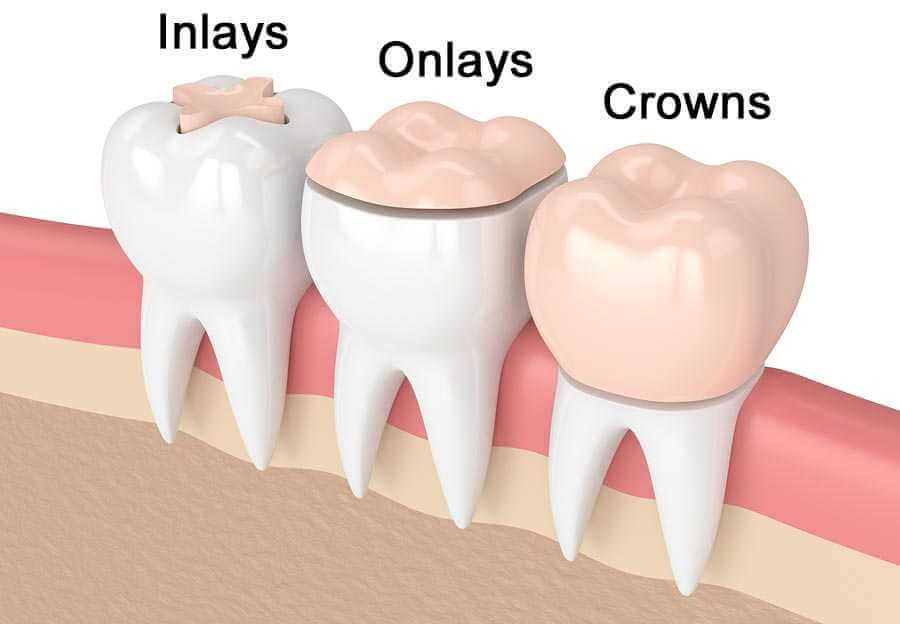
A Inlay onlay is the highest quality alternative to direct plastic fillings. A Inlay is an inlay filling, which is manufactured in the laboratory and then placed in the prepared tooth. An Overlay – also called a partial crown – goes beyond this and replaces one or more cusps of the tooth. Both are suitable for small to medium-sized defects where sufficient healthy tooth enamel is still present.
The decisive advantage compared to a direct composite filling: inlays and onlays are precisely crafted outside the mouth – they do not shrink during curing, seal perfectly, and offer long-term protection. No secondary caries, no discoloration, no wear over years.
In the Denis-Focus Dental Clinic, inlays and onlays are planned digitally and CAD/CAM milled – in our in-house lab, with a perfect marginal seal. No conventional impression, no gagging reflex, highest precision fit.
Inlay-Onlay in Hungary: What You Should Know
Inlay onlay Fillings are the highest quality alternative to direct composite fillings and clearly the better choice for medium to large defects. While a direct filling is built up in the mouth and often cured in multiple layers, an inlay is created under controlled conditions in the laboratory. The result is more precise, durable, and aesthetically inconspicuous. Inlay in Hungary to have manufactured means: the same quality (G-CAM, Ivoclar ceramics, Zirconia), the same CAD/CAM technology - at significantly lower prices.
G-CAM vs. Ceramic – which material is better?
Both materials are metal-free, biocompatible, and durable. G-CAM (carbon-reinforced composite) scores with antibacterial properties, perfect digital processability, and a bit more flexibility – ideal for posterior teeth with high occlusal loading. Ceramic (F1, F2) is naturally more translucent and is particularly suitable for visible areas. At the Denis-Focus Dental Clinic, we provide individual consultations to determine which material is best suited for your specific case.
Inlay-Onlay or Filling - When is which solution more sensible?
Minor defects can be well treated with a direct filling—quick, inexpensive, proven. For medium to large cavities, that's Inlay the better investmentLonger durability (15-20 years vs. 5-10 years for fillings), no secondary decay, no shrinkage. An onlay is useful when one or more cusps are missing – as an intermediate solution between an inlay and a full crown, it optimally protects the remaining tooth structure.
Ready for a long-lasting inlay or onlay?
Schedule a free consultation.
We will advise you personally on which material and treatment is the best solution for your tooth. Non-binding, in German.